Originally published August 2025 in the Napa Valley Register
By: Carine Hines
It is Sunday night and I am finally writing this article as I eat a bit of homemade peach pie. This last week, like any week in August, stretched me thin. Thin enough that I cannot think of anything witty or profound to write, so instead I will share a summary of what happened at Sun Tracker Farm the week of August 18th, 2025. It is my week’s post-mortem do-to list. And because I know any reader of this column is interested in farming, maybe this look back will give you a deeper understanding of a farmer’s life in August.
Sun Tracker Farm is run by myself, my husband Robert, and a wonderful employee, Maria. Together the three of us juggle different responsibilities to keep the farm one step ahead of the avalanche of produce and tasks that chase us daily. All the while, we have our family, other responsibilities, and a bit of self-preservation to eat and rest (oh did I mention I am also 19 weeks pregnant). Last week, like every week, was a team work between the three of us. Our muscles, our brains, our perseverance, and our communication got us through a hot and busy seven days!
Monday August 18th
Wake up at 5am to harvest melons, okra, cucumbers, and summer squash. Everything is brought in from the field, weighed, recorded, and put in the walk-in cooler.
Move irrigation pipe to make beds for our first plant out of fall crops (lettuce, radicchio, broccoli, cauliflower, cabbage). To make beds the soil was first irrigated with aluminum sprinkler pipe so our rock hard soil is malleable enough to work. Bed making includes mowing, creating furrows, rototilling, and laying out drip irrigation lines.
Send out produce availability to our wholesale buyers.
In the heat of the day, head to the barn to sort potatoes for future orders.
Seed the next succession of fall/winter crops according to our seeding calendar.
Enter harvest numbers in spreadsheets.
Check and set gopher traps
Irrigate, irrigate, irrigate.
Take care of the chickens.
Tuesday August 19th
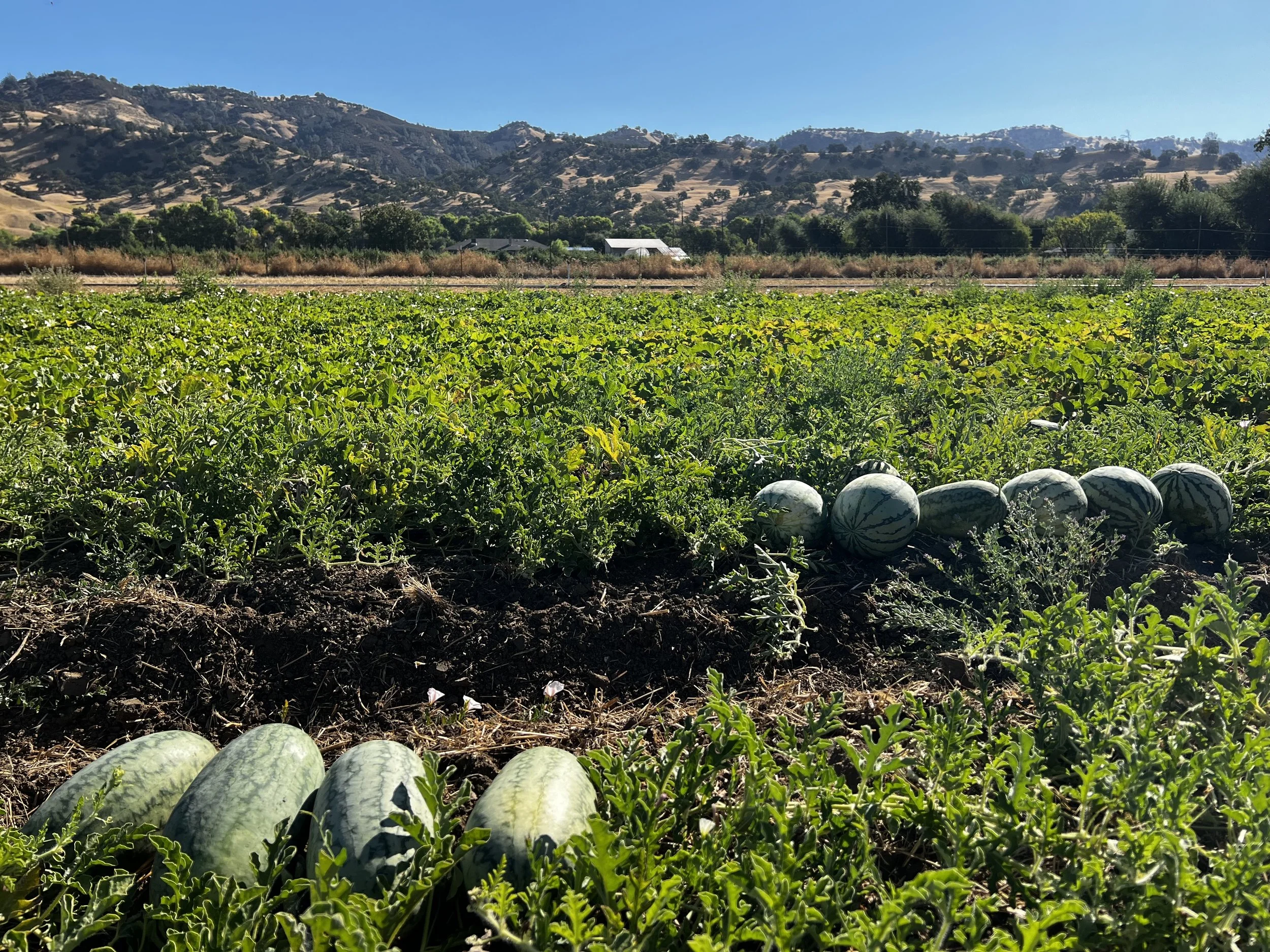
Wake up at 5am to harvest watermelon.
Transplant all fall crops and immediately water-in. It is well over 100-107 degrees this week, so irrigation is a huge priority!
Receive orders from wholesale buyers and pack them for pick up the following morning.
Enter harvest numbers in spreadsheets and write up invoices.
Check and set gopher traps
Irrigate, irrigate, irrigate.
Take care of the chickens.
Wednesday August 20th
Wake up at 5am to harvest melons, okra, cucumbers, shishitos, and sweet peppers.
Send out produce availability to our wholesale buyers. Wednesdays are even more complicated as I need to predict the yield of the next few days, consider the last few days yields and sales, hold enough for the farmers market, and try to get everything out the door to meet our customer demand. We work with 2-3 wholesale buyers per week, and attend the Saturday Napa Farmers Market. Luckily we have great spreadsheets and we keep good records.
Decide at the last minute that we need to plant our fall potatoes tomorrow. So it’s back to moving irrigation pipe and running irrigation sets.
Enter harvest numbers in spreadsheets.
Wash chicken eggs for market.
Check and set gopher traps
Irrigate, irrigate, irrigate.
Take care of the chickens.
Thursday August 21st
Wake up at 5am to harvest watermelon, summer squash, eggplant, and tons and tons and tons of tomatoes. Thursday was over 105 degrees, and it was well past noon when we finished tomatoes.
Send out produce availability to our wholesale buyers.
Move the irrigation pipe from the potato beds, bed up (see protocol above), borrow our neighbor’s tractor-driven potato transplanter, bring 300 kg of seed potatoes out to the field in the truck, seed the potato beds well past when we should be inside resting.
Enter harvest numbers in spreadsheets.
Check and set gopher traps
Irrigate, irrigate, irrigate.
Take care of the chickens.
Friday August 22nd
Wake up at 5am to harvest melon, okra, cucumbers, more peppers and tomatoes, tomatillos, basil, and I’m probably forgetting something.
Finalize orders with wholesale buyers for the weekend and Monday delivery. Making sure we have enough for everyone, and enough for the farmers market is such a mind bend.
Pack orders, fold cardboard boxes, prepare produce for the farmers market (ex. making mini melange squash pints), wash potatoes, cut onions (still need to finish cleaning all our curing onions), and so much weighing and moving and filling up the cooler.
In the evening, bring our biggest wholesale order of the week to our neighbor’s farm and palletize the produce so they can deliver for us the following morning in SF.
Prepare the van for the market so we have everything we need (oops we ran out of small paper bags and I didn’t go to the store this week).
Enter harvest numbers in spreadsheets. Write up invoices, and finally get around to counting the market cash from last week so we have enough cash in the cash box (oops we ran out of quarters and I didn’t go to the bank this week).
Check and set gopher traps
Irrigate, irrigate, irrigate.
Take care of the chickens.
Saturday August 23rd
Wake up at 4:20am to load the van and head to the farmers market.
Arrive at the farmers market at 6:10am, and set up for the starting time of 8am. I forgot to mention our wonderful market employee, Dave, who helps us set up, sell, and pack up every Saturday!
Sell produce, restock produce, and talk to all my wonderful customers until noon.
Noon to 1pm break down the market stand, weigh and record all produce that was not sold (we love data!), donate produce, and check in with a few farmers market vendor friends.
On the drive home from Napa, run a few errands for the farm, and get diesel so the van is ready next week.
Get home, unload the van, and see what farm chores still need doing.
Check and set gopher traps
Irrigate, irrigate, irrigate.
Take care of the chickens.
Sunday August 24th
I would love to say every Sunday is a day of rest. We try so hard to make it so, but the truth is we sometimes need to squeeze in an extra project. This week it was slaughtering our old layer hens. Past two years old, hens stop laying eggs, and we cannot afford to keep pet chickens. So we close the circle by turning them into stewing hens.
Wake up at 6:30am (wow sleeping in!) to gather chickens, and prep the slaughtering station. Luckily our wonderful neighbor, Sean of Channa Ranch, has a beautiful chicken processing set up that we can borrow.
Slaughter chickens until about noon. This includes, killing, plucking, eviscerating, bagging, weighing, and freezing. With lots of clean up to add. It’s one of our least favorite days of the year (hello vegetable farmers), but having animals as part of our farm’s rotation brings us so much balance and soil fertility.
Irrigate, irrigate, irrigate.
Take care of the (live) chickens.
Bookkeeping, invoicing, planning for the next week, and finally, writing this article.
We are just a small farm of 8 acres and three people, so you can extrapolate this outward or inward to think of smaller and larger farms. The point is, in peak season there is so much to do, so much to coordinate, and so much we cannot forget to do or else there is a good chance something will die. It is brutal and demanding, but even after all that, we still love it. And we finished the day with a swim in the creek with our kids, eating a picnic of tomatoes and watermelons. August is not all that bad afterall!