
Originally published August 2025 in the Napa Valley Register
By: Carine Hines
Today, I struggle to write. I know what I want YOU to know, and that I could show you with words how it feels to live in the farming community today. But I do not know how.
I cannot find the words to express my grief and anger in witnessing what is happening in the agricultural community. It is too much to fathom and accept as reality. I will digress just long enough to say that the racist and illegal targeting of the farmworker community through farm raids and arrests in vulnerable agricultural communities (mine included) is causing terror and uncertainty beyond anything before. The agricultural industry and American food system is entirely dependent on immigrant farmworkers. Without them, we are quite literally removing the hands that feed us and ripping apart the people and families of this land. If you like to eat, then I highly encourage you to raise your voice to stop what is happening to the people of America.
I cannot find words to say more on that subject, so instead I will share a few stories and lessons on farming. When someone starts farming, or thinks of farming, I doubt many people imagine that irrigation will be one of, if not the, biggest sources of stress, time, and money for a farmer. I can confidently say that irrigation causes more strife and conflict than any other part of farming. Why, you may ask? All you need to do is turn on the water!
First conundrum: your water source. In cities, there is a magical utility called municipal water districts. Anywhere, you can turn on the water and it comes out at a steady pressure, forever. Yes, you do pay for this utility, but it is always there, even when the power goes out. In rural farming, it is very likely your house, let alone your farm, does not have access to public water. Instead, you get your water from either the ground (such as a well), or surface sources (rivers, ditches, canals, etc). To farm, you need at least one of these water sources to be reliable… which we know is not the case during most California droughts. Solution: spend boatloads of money to tap into multiple water sources, which allows for you to reliably access water.
Second conundrum: to get said water out of said water source you need a power source. This could be electricity, a diesel generator, propane, solar panels, a windmill, etc. But again, this source needs to be reliable (I’m looking at you PG&E and all your power shut offs), and affordable. No power = no water = dead farm. Solution: spend boatloads of money to install multiple power sources, which allows for you to reliably access water. Are you noticing a pattern? (And they wonder why it’s hard to make a profit farming.)
Third conundrum: water pressure. This concept may be the hardest to grasp, but it is undeniably the most important nuance of irrigation. If you solve for the first two conundrums, you need to make sure there is just the right amount of pressure to water your farm. Your wiggle room is about one step either way before falling off the cliff. Too much water pressure (ie you are pumping more water from the water source than is released through your sprinklers/drip lines/etc) and your whole system explodes. That means your well is broken, your pipes are broken, and you have no water and therefore need boatloads of money to fix it all. Yes, you can install pressure release valves, but if your pressure is regularly high enough to trigger the system then you will slowly cause irreversible damage. Well what about too little pressure… not as bad? Wrong. Too little pressure and you can 1) burn the pump pumping water because instead of sucking water it is sucking air, and 2) kill your plants because they are not getting as much water as they need. Once again, you will need boatloads of money to recover from too little water pressure.
I cannot tell you the hours we spend agonizing over and checking on water pressure. Because our pump is not big enough to water our entire property at once, we need to constantly switch between sets. When switching sets you need to simultaneously balance between too little and too much water pressure to protect this valuable infrastructure. A few years ago we spent a pretty penny installing a fancy thing called a VFD (a story for another time), which helped incredibly. But as in everything related to farming, there is no silver bullet. To us, hell looks like a pressure gauge, and sounds like the whistle of a pump sucking air.
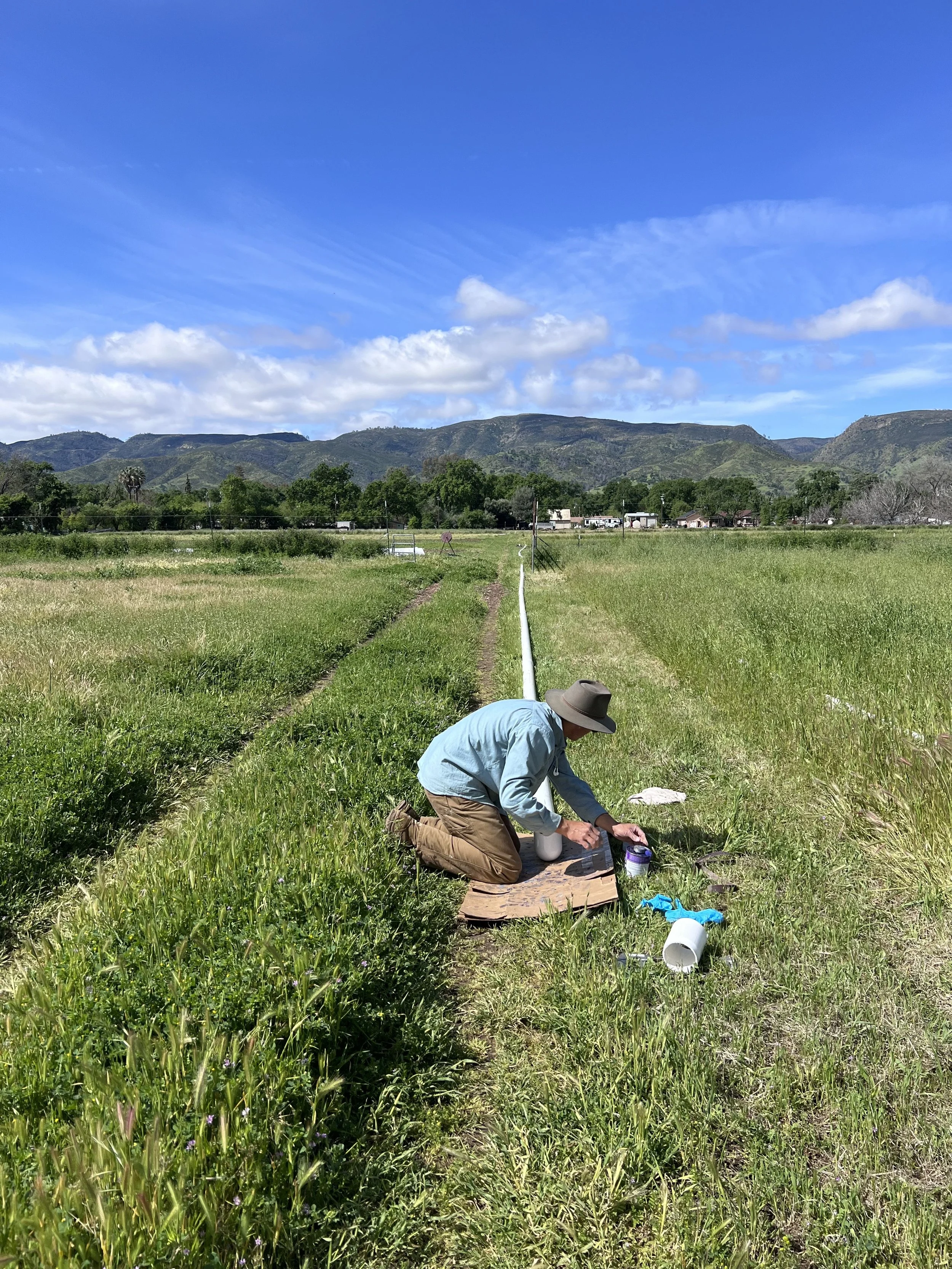
Fourth conundrum: getting water where it needs to go and not everywhere else. Once you get the water out of the water source, and at just the right pressure, it needs to reach plants at an even and consistent flow. Ideally this is also a water efficient system to save you water, energy, and money. The infrastructure between a water source and a plant looks like some sort of pipe, tube, or emitter, which are all subject to destruction by sun, machine, animal, cold, or who knows what. A list of skills and tasks needed to install and maintain said water conduit includes:
Being an expert in gluing PVC pipes and laying thousands of feet of it below ground.
Digging up and adjusting/fixing said PVC.
Diligently looking for leaks in your drip line. Sometimes you hear it, sometimes they are small, sometimes water is shooting in the air, and sometimes you just walk into a lake.
Trapping or scaring away whatever animal is making holes in your irrigation.
Deciding whether the leak in the drip line can be fixed with a couple turns of electrical tape, or cutting into the line and installing a connector. The real skill is doing this while the water is running.
Connecting and punching into poly tubing. Ouch.
Moving aluminum pipe… they are not heavy, but they have a specific balance point.
Imagining, moving, and opening the gates that direct water flow into the aluminum pipes. It is truly an art.
Unclogging sprinkler heads by winding them off the aluminum pipe, clearing out the blockade (sometimes it’s a rock and occasionally it’s a poor mouse), then winding them back on. All this done while the water is still on and shooting out everywhere.
Be really good at math so you can calculate flow, pressure, friction, etc.
Doing the above things (and more) in conditions you couldn't imagine.
In the pyramid of success for farming, water is at the base. It is the first and most important key to keep your farm alive and thriving. Be it dark, scorching hot, at the end of the day, in the middle of the night, your daughter’s wedding, or the last thing you want to do, a farmer will ALWAYS take care of their irrigation. It is the “I just need to do this one quick thing” that turns into an hour of work. All you need to attain irrigation mastery is persistence, gumption, brains, and boatloads of money.