
Originally published in the Napa Valley Register on July 28, 2026
It is 6am and twilight barely illuminates the field. You grab your harvest bucket and walk into one of the tomato corridors, with tomato plants towering around you as tall as a person. And immediately you walk into a spider web. Then another and another and another.
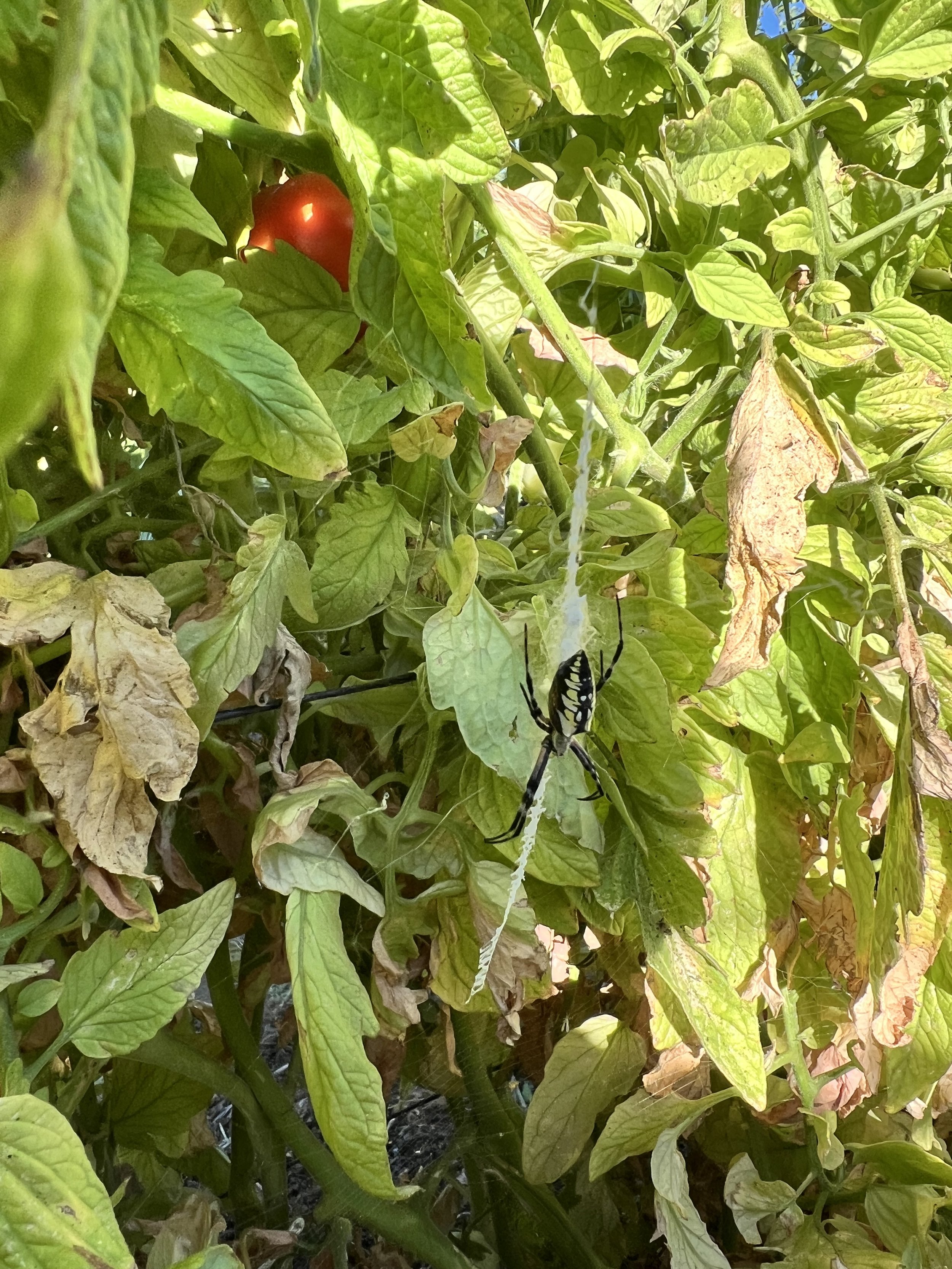
When harvesting tomatoes, spiders are your companions through all your laborious harvest. Be it a large, complex web strung across the aisle, or a colorful Garden Spider perched near the tomato you are reaching for, spiders are everywhere. If you are lucky enough to have a bit of morning dew (a rare event in the Capay Valley), hundreds of spider webs will light up as the sun rises over the hills. Looking down the corridors you will see a web of webs stretching as far as you can see, each a little universe for a spider.
Spiders are the most omnipresent creature on our farm. They inhabit every corner of the field, barn, and house. In the morning I find them in my boots, having spun a small web during the night. They crawl into our harvest buckets, shelves, and cars. Every toy left outside by my sons inevitably becomes colonized by a spider. The spokes on our bikes are reinforced by spider webs. In the house they make a home by every light and lamp, window nook and ceiling corner. We even keep a “pet” spider in the corner of our shower window, and lovingly named her Shelob. Shelob has been my shower companion for almost two years now! Out in the field they are found under almost every leaf, or clod of soil.
To most people spiders are all equivalent to each other, and they do not realize how many different spiders live all around us, with each their own adaptations that allow them to thrive in all sorts of environments. Instead of shying away from a spider, we can stop to observe, learn, and realize their diversity. I am by no means an expert on spiders, but I can name a few that accompany me throughout my daily life on the farm
Most common in our buildings are the Daddy Long Legs, or Cellar spiders, which are actually a common name ascribed to over 200 species of spiders. But when darkness falls, the Black Widow spiders come out with their sticky and disorganized webs draped across the garage and packshed. To me these are the most beautiful spiders, with bodies so shiny and black they seem to be made of the night.
There are the adorable and tiny Jumping Spiders that hop around all our crops. If I walk at night with a headlamp across an expanse of field or grass, there is a Jumping Spider every few feet making itself known by its iridescent hairs reflecting back the light. In our piles of mulch or on hillocks of soil, Trapdoor Spiders make a web tunnel with hinged doors to lure in and ambush their prey. Crab spiders with their front legs held together like claws scuttle over my melons, hunting without a web. Orb-weaver spiders make majestic webs in the tomatoes and eggplant. My personal favorite are the Wolf Spiders, a large brown spider that hunts without a web, carries their egg sacks under their abdomen, and can be found in the field or occasionally on our ceilings. I sometimes wish I were an arachnidologist just so I could know the secrets to each of the hundreds of spider species on our farm.
While spiders are perhaps the most prevalent and masterful predators on the farm, we also host many other fascinating insects that eat spiders. The Thisbe’s Tarantula Hawk Wasp paralyzes its spider prey to create a living meal for its larvae. Mud Dauber wasps make mud nests in every nook of our outdoor area. If you break open an old mud nest, you will see it packed full of spider caracasses the wasps used to feed their young. There are even Black Widow Mud Dauber Wasps who hunt Black Widows and use the mud nests of previous daubers to feed and raise their larvae. The insect world is an eat-and-be-eaten balance of life and death that is vital for our larger ecosystem.
In our home we tell our sons, “Spiders are our friends”. We try to identify them, learn their way of life, and think of the role they play in keeping the farm healthy. If they find one in the house, instead of screaming, smashing, or shuddering, they find a glass and paper to move them outside. Most of us have the impulse to be scared when we see a spider, but maybe this is an unnecessary learned behavior rather than a helpful act of self-preservation.
What I mostly feel when I see all the spiders that inhabit every corner of our farm is a sense of doing the right thing. If our farm were not a healthy and complex ecosystem for its inhabitants, plant, insect, animal, or microbial, we wouldn’t have all these spiders. Farms that spray pesticides and use synthetic fertilizers do not have spiders everywhere. Spiders are the banner waving in the wind, reminding me every day that all our efforts to heal and improve the health of our farm are working. Spiders are my friends, and every day give me the gift of a vibrant farm.