Originally published March 2025 in the Napa Valley Register
By: Carine Hines
Sometimes, it’s hard for me to connect with people who are not farmers. When even my dear friends and family do not know and understand the deep and daily connection I feel to the land, weather, and nature… well it makes me feel distant. I live in this whole other universe that revolves around today’s texture of the soil, the dryness of the wind, the weeds that are in season, and the insects that are eclosing.
It is not that non-farmers do not appreciate this agrarian point of view, rather it is not a crucial part of their day and the guide for every decision they make. Their world can exist and continue steadily, no matter what happens outside. As a result, their focus is drawn from the land and nature to the synthetic and illusionary world built by humans. This bubble of humanity is beautiful in its own ilk, full of music, expression, culture, joy, pain, and beauty. Yet it is not real, and it is unconnected to the natural world. No wonder humans are astounded each time nature bears its fangs.
When I feel too distant from… well almost everyone I know, I remember that we are still connected by land and ancestry. The investment banker, the painter, the stay-at-home-mom, the college frat boy, and me, the farmer, we all have farming in our blood. For some of us, you only need to look back one or two generations to find the farmer in our family, and for others it’s a black and white photo on a wall of an unknown relative whose unsmiling face seems as unfamiliar as the idea of writing a letter. And for some even, these farmer ancestors are a complete unknown. In this country’s beautiful mixing pot of immigrants who started new in the land that promised so much, they could have left behind their identity as farmers to become people of cities and industry.
But somewhere back there, we all had someone who was a farmer. If anything, this can tie us together, and tie us back to the land who holds us in her arms.
For me, you could most definitely call my mother and father farmers. My father was a California native plant nursery grower for most of his life, and my mother grew up on a farm and later became a plant breeder. In her retirement she finds herself back on the farm, cleaning her daughter’s cured onions and prepping my customers vegetables for the farmers market. Meaning I continue an unbroken line of farmers, likely all from the the same corner of southwestern France, to my present place nestled in California’s Capay Valley.
Today I want to tell you about my grandmother, Marie Jeanne Gary, who was born on a small farm in the town of Casseneuil, France where her nephews still farm today. She grew up in an old stone house amongst prune orchards (the purple gold of southwestern France) and cows. Her father was a man of the land who made the best wine my family can still remember, and died out in his fields, in the soil he loved. Her mother was a hard woman, with a Catholic mother’s austere love, the straight back of a farm wife who saw two world wars on her home land, and the owner of a small motor bike that she once ran into a pile of grain when the brakes gave out.
Marie Jeanne did not have an easy childhood, but it was also beautiful. As a girl she was sent out to the fields to babysit the cows, where she would play with her only doll until she noticed the cows were nowhere in sight. As I said, her mother never showed her soft love, and as a result she grew up to be the most loving woman I have ever known, but never once hugged me.
Marie Jeanne met my grandfather, Roland Galinou, after WWII at a Young Farmers excursion to Paris (yes, they met in Paris even though they lived in villages 15 minutes apart). They married and eventually moved to the farm next door to Marie Jeanne’s parents, after her father bought it for them. To his dying day my grandfather said he lived at my grandmother’s farm.
Together they build a farm of prunes, grains, dairy cows, children, and so much more. While my grandfather built the farm stone by oak beam, and plant by animal, my grandmother was everything else. She always occupied the space in between the bigger farm landmarks. She was the chickens in their yard, the flowers in the driveway, the garden beds, the daily meals for 12 people, or the prunes soaking in eau de vie for a cold winter day. In fact, she probably never called herself a farmer, yet she was the best of any of them. Later on, one of her sons would become the largest bonsai tree grower in Europe, and when he had a sick tree, he would bring it to her. She had this little magic that could bring any plant or animal back to life.
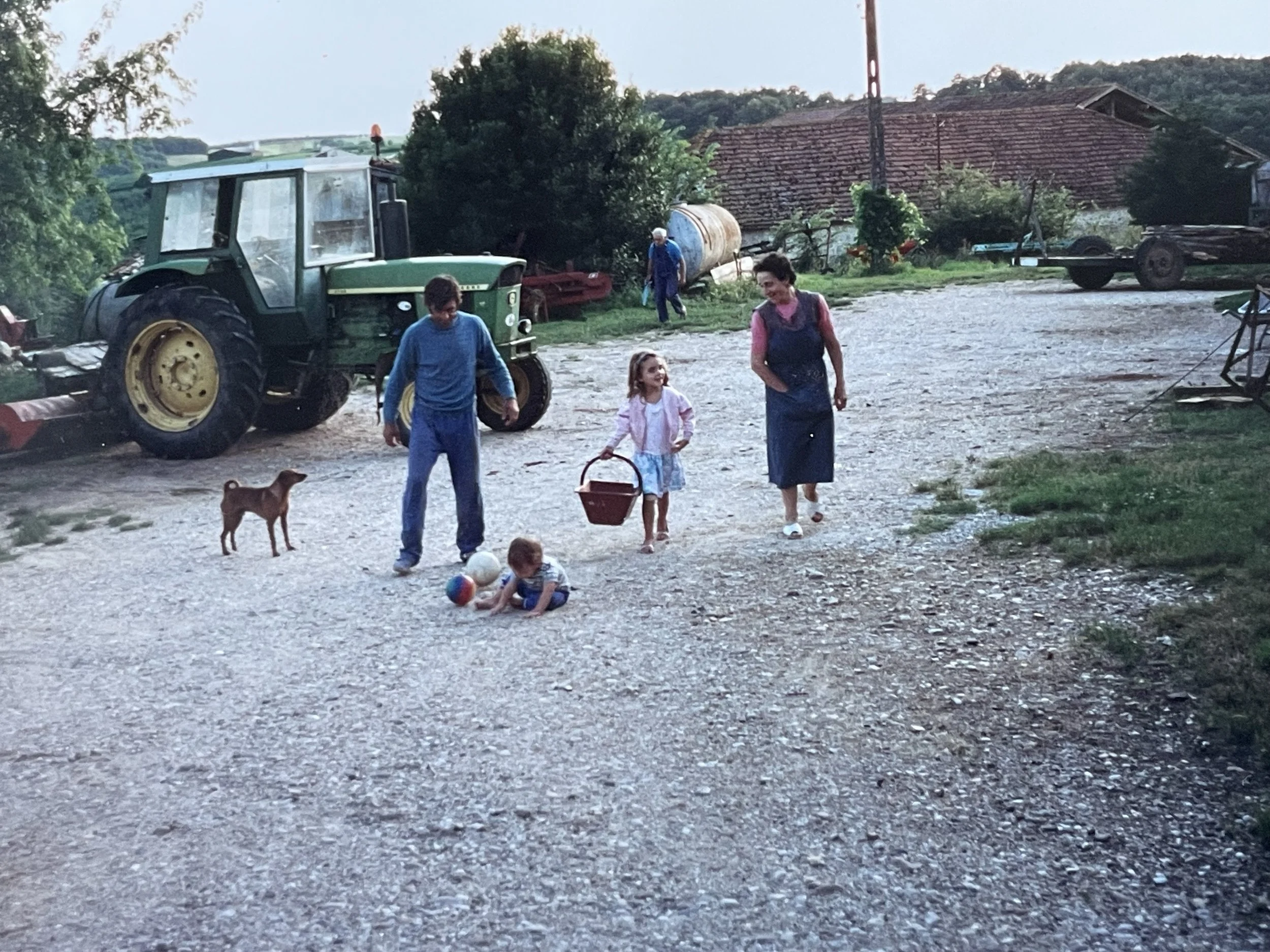
The memory I will carry with me until my last day is our evening walks. Around 6pm, when dinner was mostly prepared and my grandfather and uncles were milking and feeding the cows, we would slip into boots and make her round. Bring the kitchen scraps to the chickens and collect the eggs, cut grass for the rabbits and tend to their hutch, walk down to the small barn to crack corn for the ducks and guinea fowl, then down to the cows to scoop fresh milk out of the tank. Finally, we would walk back up the side of the farm on the road covered in old oaks. As a girl I loved to watch and help her with this daily routine.
Today, I similarly take an evening walk with my boys when it is time to take care of the chickens or harvest veggies for dinner. While I may not finish my day walking under the same old English oaks as I did with my grandmother, I do walk past fields of cover crop, looking out to the golden hills of California dotted with valley oaks. Without fail, this is when I feel the most happiness and excitement. Excitement for my day, for the future, for the farm, and for my life. I feel the legacy of my grandmother, and each farmer woman before me.
If we each search back far enough, we can find the farmer that came before us and whose knowledge still lives somewhere in each of our untapped memories. We cannot all become farmers, but we can remember that we each came from farmers. We each came from someone who lived by the land and for the land, and who set their daily routine to the live things they tended. May this be your compass, and if you are lost may it guide you back to where you belong, where we all belong. In the land and of the land.