Originally published April 2025 in the Napa Valley Register
By: Carine Hines
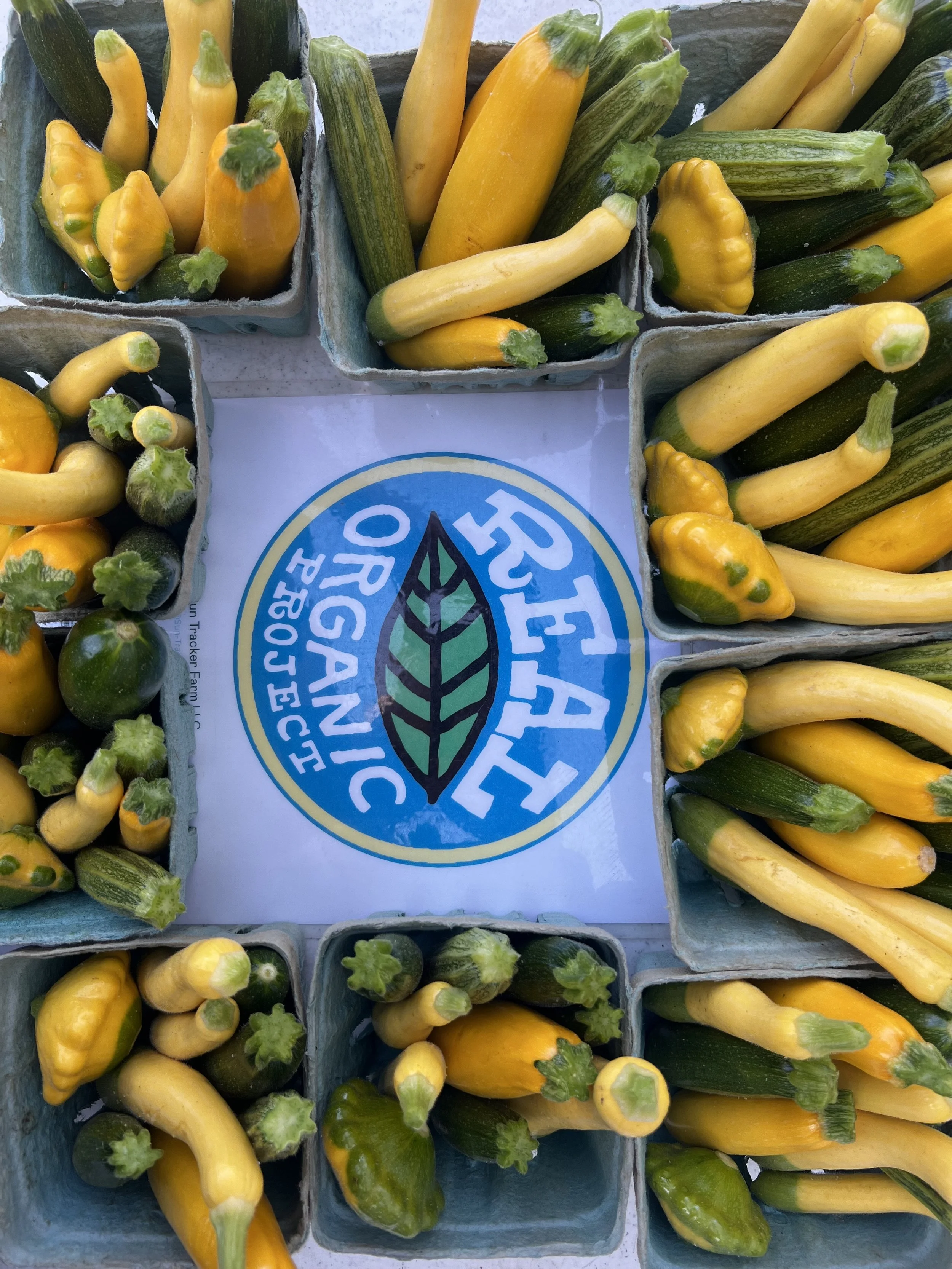
If you ever frequent our farm stand on a Saturday morning at the Napa Farmers Market, you may notice two signs proclaiming Sun Tracker Farm to be certified organic. The first sign is from CCOF, our organic certifier who conducts annual inspections on our farm and to whom we report production practices, production yields, and any implements we add to our soil or crops. In addition, we have a sign for our participation in the Real Organic program. What does it mean to be Real organic certified, and why are many small to mid-scale organic farms seeking an additional organic certification?
A few weeks ago the Real Organic Project invited a group of certified organic and Real Organic certified farmers to a dinner at Full Belly Farm. Around one large table and a shared meal, dozens of farmers of all ages and specialities, shared our common challenges, opportunities, and plans for the future. Many recurring themes came up, most resonant of all is our commitment to small, sustainable farming that produces food while healing and protecting the environment. All of us see farming as not a “profitable” industry in which we pour our sweat, blood, and tears for the return of wealth. In fact, if high profits were our goal, none of us would have been sitting around that table. Instead we see farming organically, by farming “real-ly” organic, as how we can use our vocation to fill that unyielding drive to grow food sustainably and to make a difference in the food system.
Some organic farmers across the country are dissatisfied with where we find ourselves in the national definition and boundaries of what makes an “organic farm”. Each farmer likely has their own call-to-action in describing where certified organic falls short. I can share several examples of these issues, but my overall takeaway is that organic farming is heading ever closer to industrialization rather than staying firmly grounded in our most vital resource and partner: soil. In anything, when you lose sight of what grounds you to the core aspect of your enterprise, you cannot succeed. For example, the Napa Farmers Market would not be successful if it forgot its farmers, schools would fail if they did not value their students, and organic farming will not stay meaningful if it ignores the value of soil.
One of the most unifying concerns amongst organic farmers is the USDA’s decision to allow hydroponically grown produce to become certified organic. Why, you may ask, is this so egregious and causing strife between farmers and organic certifiers? It all comes down to soil, sustainability, and biodiversity. To be an organic farmer is to realize that soil is not an asset that depreciates in value over time until it is rendered useless. Instead, soil is a live, growing partner on your farm, whom you must nurture and with whom you collaborate to grow food. Instead of depreciating soil, organic farming builds its richness and health over time. In this way, we can grow food that, yes, may have a few cosmetic flaws, but is ultimately more nutritious and the outcome of a net carbon negative cycle.
Allowing hydroponically grown produce to be certified organic, is to say that growing food in a sterile, plastic environment, with energy-intensive fertilizers and artificial light, is equivalent to a farmer who puts as many resources into growing food as they do in growing soil health. It is not apples to apples, and no matter how many solar panels or recycled materials you may use, hydroponics can never equate to sustainability. Meanwhile, an overwhelming amount of produce found in our grocery stores are now hydroponically grown, deceiving you with their artificial perfection that they have the equivalent nutrition and carbon footprint as “real’ly” organic produce.
And yet, if hydroponic agriculture were the only problem with organic agriculture, I would feel less overwhelmed. As organic agriculture becomes more mainstream, it continues down the path of industrialization and keeps the consumer away from the farm. Even non-hydroponic organic agriculture can be extremely extractive and inhumane. Here are a few examples of what keeps me awake at night:
Virtually every organic strawberry in California is grown under plastic or in soil that was solarized under acres and acres of plastic.
Food safety regulations require farms to remove biodiversity of plants and animals in and around fields at the small risk of a bit of bird poop landing on a lettuce. And this is despite knowing that the friend of epidemics is monoculture, and its enemy is biodiversity.
When you find melons or any summer fruit in the winter, they likely came from the southern California deserts where large-scale farming dumps water and outside “organic” fertilizers into an ecosystem this is not meant to be agricultural.
Organic dairies are more compliant to regulations when the animals are enclosed in indoor dairy lots for their whole lives.
Organic farming requires more labor, as chemicals are not at our disposal for pest and weed management. This labor is done by humans, and humans who deserve to be paid a living wage. Organic farming could and should stand for the equitable treatment of our workforce.
It is not too late to reground organic farming into its original intention and what it needs to be in order to create a sustainable food system. The Real Organic project is one way for farmers to rally around our values, and teach society what we see is wrong in our food system. But the most powerful way to make change in the right direction is for you, the consumer, to be knowledgeable of where and how your food is grown. My suggestion: when thinking of food, stay grounded in organic, local, and sustainably grown food. Afterall, it is only 10 inches of topsoil that feeds our entire society. Without it we have nothing, and that more than anything should be a reason to eat food from the farmers you know.