Originally published April 28, 2026 in the Napa Valley Register
By: Carine Hines
“Agh, get away, give that back!” I exclaim while shoving away a chicken who just pecked me as she tried to tuck an egg back under her fluffed up, broody-hen feathers. No matter how many times I harvest chicken eggs, I always get annoyed with these territorial little hens.
I am not, and never have been a big fan of chickens. It is probably unfair of me to say so, but I do not like their flightyness, the way they smell, how they peck at you, and how they love to eat their own eggs. And if there is a more cannibalistic animal on earth, please let me know, as I’ve witnessed chickens inflict cruelty upon their fellow sisters that I do not dare put in writing. Nothing riles me up quite like an evening rustling chickens out of my way and fending off an angry rooster. Despite my antipathy towards these creatures, I somehow ended up a chicken farmer.
Perhaps it is destiny, as my French family name, Galinou, means poultry. After several generations of cow farmers, the line had to eventually come back to chicken farming. So here we are with a 200 bird laying hen flock that I lovingly/unlovingly call the velociraptors. The nickname came about after watching a flock of chicks hunt a colony of cockroaches we found in the compost pile… the resemblance is uncanny, and after all birds are distant descendants of dinosaurs.
Our laying hens only represent 5.7% of our gross income, and the expenses account for 9.4% of our total expenses, and that does not include the labor and energy cost to irrigate their pasture in the summer, and the labor cost of Robert and I doing all the things we do (see below) to have healthy, happy chickens. Overall, it’s a guaranteed net loss in dollars, so why would we ever have chickens on our farm?
We added poultry to our farm in our second year of farming. Inspired by our mentors, such as Nigel Walker of Eatwell Farm and Tim Mueller of Riverdog Farm, we wanted to have a farm that did not solely rely on compost and cover crops to return nutrients and biodiversity to the soil. This was before Regenerative Farming became a hot topic in the farming world, but it made sense. Compost, despite its many attributes, is still a soil input that comes from outside of the farm. Adding animals to the farm’s rotation brought in vital nutrients such as nitrogen and phosphorus, increased microbiological activity, and possibly some sort of weed management.
In the winter of 2018 Robert and his Dad built a mobile chicken coop on the gutted frame of a flat bed trailer, and we ordered 100 chicks and 20 goslings. Since then, we found a comfortable rhythm in having 200 laying hens and about 10 geese on the farm. Every year we cycle in 100 new hens, and cycle out 100 (or often less due to mortality rates) 2 year old hens. It guarantees we have a steady supply of eggs, and a flock that fits comfortably in our coop.
The geese lay eggs in the spring to cover their own cost, but they are mostly present as protection from small predators such as eagles. And while I do not love chickens, I love geese. In comparison to chickens they are so much smarter and more social. They have strong personalities and an awareness of the world that is fascinating to watch. For example, when wild geese fly over you can see our domestic geese all tilt their heads sideways to watch the wild geese fly by.
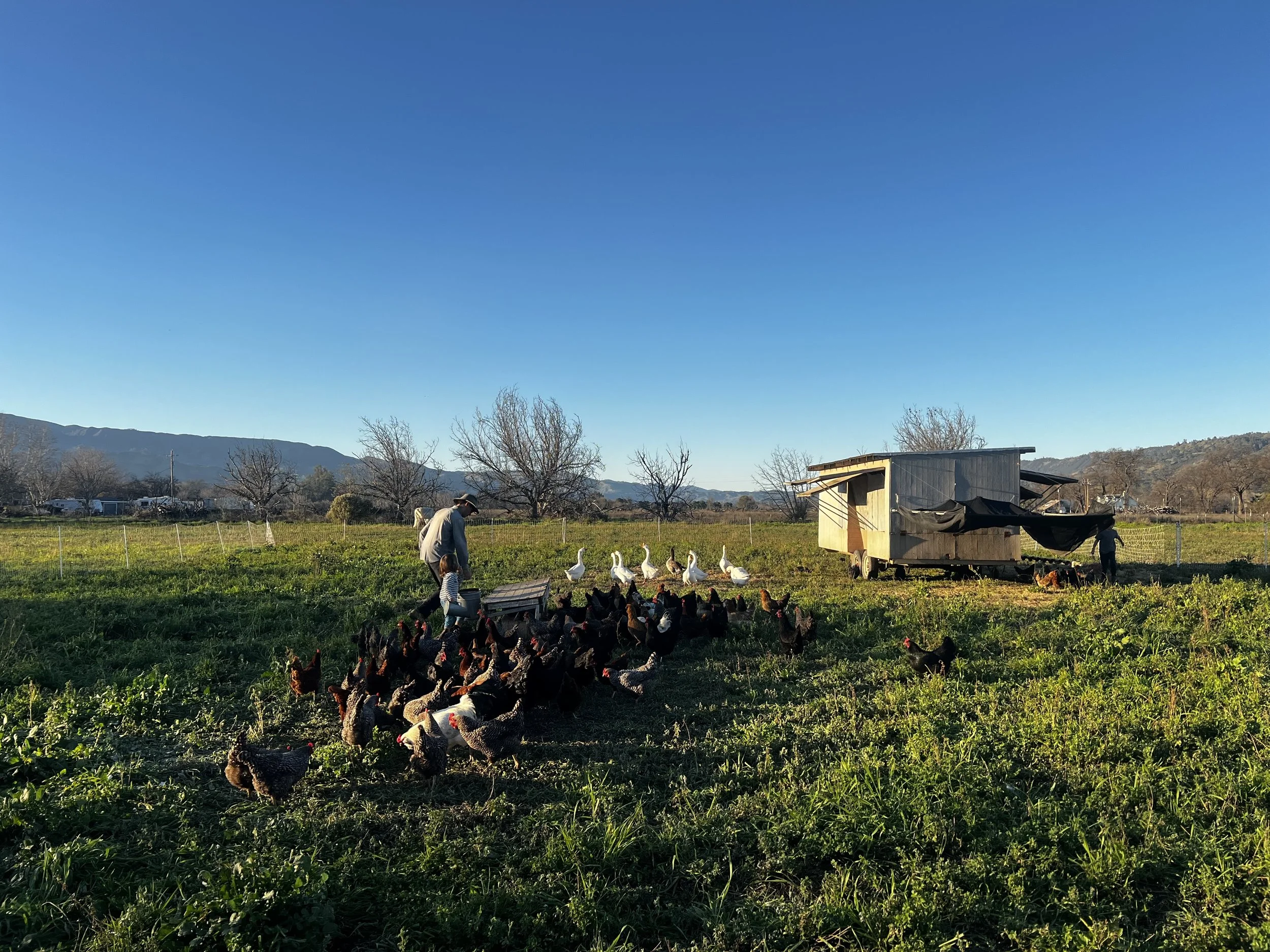
Our flock of hens and geese live on a perennial pasture of alfalfa, rye grass, clover (and plenty of weeds). Winter rains mean less work because we do not need to irrigate the pasture, but from about May through October we are almost daily irrigating the pasture with aluminum sprinkler pipes that are periodically moved. An irrigated pasture means our birds have year-round access to fresh forage and are not just scratching bare dirty in the summer.
Aside from the daily trip to feed, water, and collect eggs, the mobile chicken coop is moved two times per week. Every Wednesday morning Robert moves the coop and birds to a fresh 1200 sq ft area of fresh pasture by moving an electric fence, their feeder, and hooking up the coop to the tractor (with chickens still roosting inside). After moving everything he then cleans out the coop and spreads fresh straw inside. The whole process takes about an hour, unless the geese went out for an adventure and need to be herded back in. Then on Saturday he again moves the coop within the fenced area. Chickens tend to stay near the coop so to make sure they don’t destroy the plants in one area and spread out their manure, the coop needs to be moved often.
Every year, significant time goes into raising new chicks in a brooder, transferring them as pullets to a mobile chicken cage, then adding them to the main flock at about 5 months old. In addition, we process on-farm (i.e. slaughter) our 2-year-old hens when the pullets start laying, and sell them as stewing hens (so as not to have 100 pet chickens). As you can see, it represents a huge amount of work on the daily, weekly, and annual basis. And there are countless other things we need to address such as broken equipment, dead or injured birds, predators, paperwork and inspections, etc.
So again, why would we have laying hens on the farm when they do not represent any real profit? The answer is joy and soil. First off, they bring joy to our customers and to ourselves. Our customers love our eggs, not only for their incomparable flavor, but also because they want eggs from hens that live a happy and healthy life. And despite all the work (and my antipathy towards chickens in general), they do bring us joy and satisfaction as farmers. Seeing our happy flock explore their pasture on a balmy evening, or our kids learning to care for animals, makes our farm complete.
Most importantly, we have chickens on the farm because of what they do for our farm’s soil. We always expected it to be true, but last year we took part in a soil health study with UC Cooperative Extension that proved how important our chickens are to the overall health and longevity of our soils. In a side by side comparison of a field that was farmed for several years (with annual compost addition and cover crops) compared to a field that had the chickens + perennial pasture combo for 3 years we saw remarkable differences. On the chicken pasture field everything was better: soil organic matter, nitrogen, other nutrients, microbial biodiversity, etc. All our work in raising chickens and selling eggs is indeed worth it.
Having animals in rotation on a farm is a huge endeavor to expect from a farmer, both in cost and in labor/headache, but I do believe it is the key to sustainable farming. This could be with chickens, but it can also be with other animals such as ducks, sheep, goats, pigs, or cows. Supporting small farmers and ranchers who want to include animals in their farm can only be possible if customers are willing to pay the true cost of eggs, meat, and dairy. At a policy level, we need regulations and subsidies that support producers who are willing to truly raise sustainable, happy, and healthy animals, rather than factory egg mills and meat lots. You can help make that choice when you go out and buy your next dozen eggs.