Originally published March 2023 in the Napa Valley Register
By: Carine Hines
The further our economies shift towards industrialization, the more we become dependent on plastic. According to the United Nations Intergovernmental Panel on Climate Change (IPCC) within 10 years our planet will cross the threshold of catastrophic global warming if we do not immediately transition our economies away from fossil fuels. While plastic is only a small part of our greenhouse gas emissions, it is worth noting that almost every bit of plastic that was ever made still exists in some shape or form, and that plastic was made from fossil fuels.
For those of you who shop from small farmers at the farmers market, today you get a picture of a small vegetable and fruit farm’s plastic footprint. With this knowledge you might better understand why shopping from small farmers can lead to a less plastic-dependent economy, and how much more we can improve.
When it comes to plastic consumption in cultivating soil and establishing soil fertility, organic farming has many advantages over conventional farming. If soil nutrients primarily come from cover crops and compost rather than fertilizers, that means nutrients are not brought in plastic barrel drums.
When it comes to actual field prep, one of the biggest consumers of plastic is the plastic mulch tarps that many farmers use to cover soil. Plastic mulch is one of the primary techniques organic and conventional farmers use to mitigate weeds, but it is almost impossible to recycle. This means every season dumpsters full of plastic mulch are sent to landfills. Plastic tarping is also used for soil solarization, in which heat is captured under plastic tarps to kill weeds and reduce soil pathogens. Again, this technique is used by both conventional and organic growers. While it reduces the use of herbicides and pesticides, my stomach flip flops when I see acres and acres of strawberry fields being solarized before then being bedded up with plastic tarp, and finally being planted with strawberries.
By default, a small farm uses less plastic mulch because we simply do not have the machinery and resources to install it effectively, and because some farmers make the active choice to not rely on single-use plastic. Many small, organic farms use plastic tarps to solarize, but they do roll up and reuse the plastic tarping season to season. Plastic is an undeniably useful tool when it comes to managing weeds, that can only be substituted by herbicides, mechanical cultivation with a tractor, or by hand weeding. All of which have their own limitations and downsides. And no, biodegradable plastic is not a solution for this problem as it can interfere with soil chemistry.
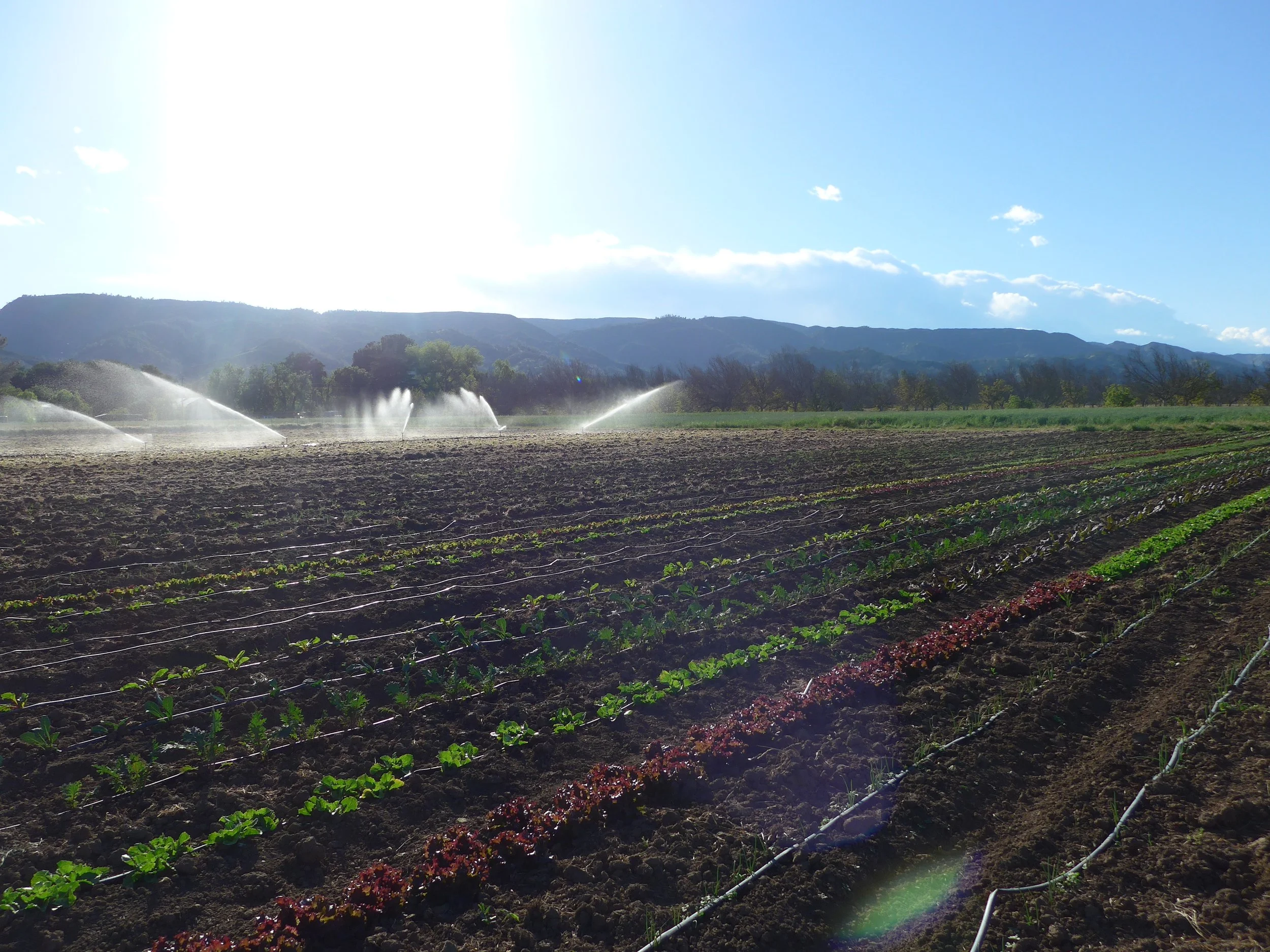
Irrigation is another large consumer of plastic. In vegetable row crops you will often find either aluminum sprinkler pipes or plastic drip irrigation, while in orchards your will find plastic sprinkler pipes or flood irrigation. Over my years farming I learned that using water efficient irrigation systems unfortunately leads to a more plastic-consuming irrigation system. Using aluminum pipes to get water from a well or river leads to so much more water loss than installing underground plastic PVC pipes. Once the water reaches the crops, a farmer either uses inefficient aluminum sprinkler pipes, or uses water-efficient drip irrigation line. Farms will often reuse their drip line by rolling it up at the end of a crop’s season and reusing it the following year. Unfortunately drip line is fragile and reusing it can mean uneven irrigation and leaks.
Once a crop’s harvest time arrives, the final main consumer of plastic is packaging. During harvest, crops are often collected into plastic bins or crates as they are light and stackable. Plastic crates do have a long lifespan, but over time they need to be replaced. Crates are used to bring crops in from the field and to consumers at farmers markets, or they are used to bring the crops to the pack shed where they are repacked by weight into boxes and bags. At a small farming scale, “dry crops” such as potatoes, eggplant, squash, etc can easily be sold to wholesale outlets in cardboard boxes. “Wet crops” such as lettuce and greens require an additional plastic bag or can be packed in waxed cardboard boxes. Either way, you can see that produce purchased directly from a farmer requires less packaging, be it plastic or paper. Buying produce from a grocery store means several extra steps of plastic packaging to get from the field to your pot.
Farming involves many more plastic-reliant steps, such as propagating in the greenhouse, row cover in the field, and more, but today you saw a picture of some of the main plastic-reliant parts of farming. There are countless reasons why it is environmentally better to purchase food from your local Napa Farmers Market. One being that buying directly from small farmers can decrease your plastic footprint, and it may even inspire you or your children to transform the future of food into one that does not rely on single-use plastic.