Originally published December 2025 in the Napa Valley Register
By: Carine Hines
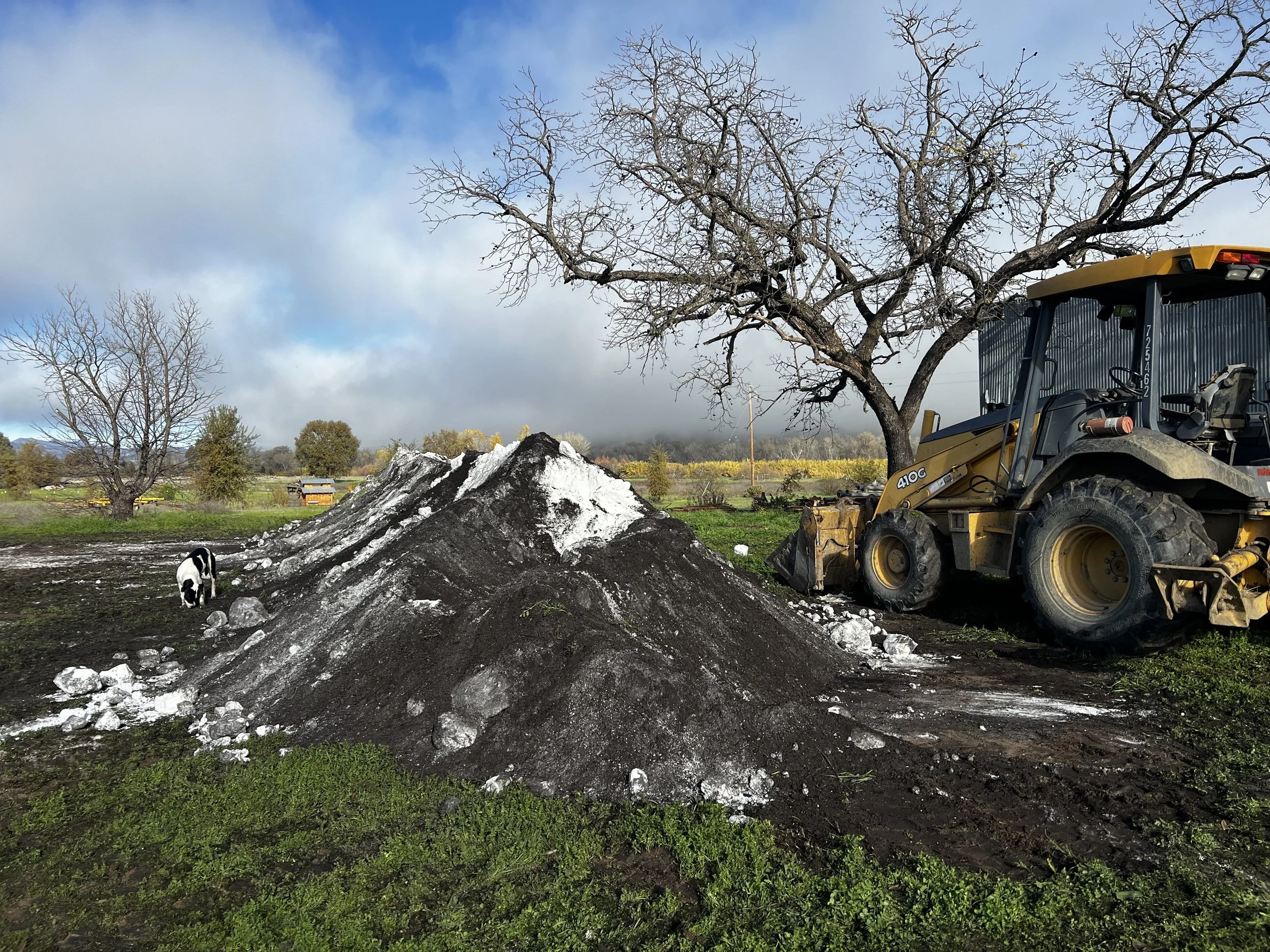
It’s that time of year… after months of looking at 66 tons of black, ripe compost and 22 tons of powdery, white gypsum that was delivered to the farm in September, it’s time to spread it on the fields. If you can’t quite imagine what 88 tons of compost/gypsum looks like, imagine several swimming pools. Spreading this black and white gold on our fields is a crucial, annual milestone for our ~10 acre, organic farm.
As you can imagine, it would be an extremely daunting and time-consuming task for us to spread the compost/gypsum by hand or by wheel barrow. Some small farmers use a truck bed or front end loader to slowly spread it out, but that still represents a lot of physical labor on the farmer’s body. Ideally, it is spread with a large, tractor-powered compost spreader. Compost spreaders come in several shapes and sizes, but the system we use looks like a trailer with tall, slanted sides. At the bottom of the trailer is a conveyor belt and spinning “wheels” that, powered by a tractor’s PTO, grabs the compost and flings it out to the back and sides. Ideally this spreads a relatively even layer of compost and gypsum wherever we drive the tractor.
The size of compost spreaders vary, but if you think back to what 88 tons of compost/gypsum looks like (several swimming pools) then you may imagine that we can’t spread it all in one load. To spread 88 tons we need roughly 40-50 trips back and forth to the compost/gypsum pile and back out to the field. Now comes the next obvious problem, how do you get the compost/gypsum from off the ground, into the tall compost spreader. With a shovel it would take days, meaning in addition to a tractor and compost spreader we also need a tractor with a large front end loader bucket.
Now you do the math, how many small farms own or can afford to purchase all three of these crucial pieces of equipment that combined represent at least $100,000? The answer is not many. You can pay certain compost companies to spread soil amendments for you, but this also comes out to a pretty penny. And remember, this is an annual cost that is crucial to the success of an organic farm.
There are many programs, both private and governmental, that will help farmers pay for the cost of purchasing compost and gypsum. To name a few, the USDA’s Natural Resource Conservation Services, the CDFA’s Health Soils Program, and several others. While these programs do provide a helpful cost-share contribution to farmers implementing soil health practices, they go nowhere near covering the direct and indirect costs of spreading compost. Unfortunately, these programs are often under a strict timeline and come as refunds, meaning the farmer MUST incur costs up front when purchasing soil amendments, AND spread it on their fields by a certain date. If a farmer cannot afford these costs or do not have time to get it done in time, their contracts are terminated. These are truly wonderful programs that the government and organizations should invest in, but they can also represent a commitment and burden farmers are unwilling to risk.
So why would a farmer go to all this trouble and financial burden to get soil amendments such as compost, gypsum, ash, etc on their fields. If the farmer is organic, there really is no other way, other than planting cover crops and rotating animals on the land, to get the vital nutrients, biodiversity, and soil health to grow organically year after year. Crops need healthy soils with high nitrogen and carbon, amongst other nutrients, in order to grow. Even with the use of organic fertilizers, the composition of the soil is crucial for its long term success. Farming crops is, no matter what, an extractive process that needs intentional regenerative steps to counterbalance the harms of farming. All the food we harvest takes nutrients out of the soil, and the water we use to irrigate our crops often has minerals such as sodium or magnesium that accumulate in the soil. Soil amendments, be you an organic or conventional farmer, rebuilds your soil, balances the minerals and pH, and helps you grow crops. We simply have no choice but investing time and money into soil health.
For not the first time, I will wax poetic about my wonderful farming community in the Capay Valley. Without the support of neighboring farms, we would not be able to farm with as much grace or (moderate) success as we do. Every year, our neighbors, such as Full Belly Farm and Riverdog Farm, lend us a compost spreader and front end loader so we can replenish our soils for the next season. It is still a stressful milestone at the farm… oftentimes we can only borrow the equipment for a short period, equipment can break and we need to fix it, or conditions such as wind or rain can add complications.
This year, Robert got the greenlight to borrow equipment Friday afternoon (after finishing up harvest for market), spent several hours getting it to the farm, mixed the compost and gypsum in the dark (mixing it saves time and helps it spread more evenly). He then went to the farmers market on Saturday from 5am-3pm (me being pregnant means I can’t help much), got home Saturday and started spreading until dark, then picked it back up at 5am this Sunday. As I write at 2pm Sunday, he is just about done spreading and thankfully everything went smoothly. We will wash and check over the equipment before returning it, and send our many thanks to the farms that help us get by.
Building soil health with organic practices such as adding soil amendments is vital to an organic farm’s financial success. Equally important is a farm’s access to the expensive equipment needed to implement these practices. In my community, we have an unofficial system of helping each other out, paying favors forward, and always looking out for the person in need, the young starting farmer, or ways to share infrastructure and equipment. This community is not present everywhere, and is even more hard to access for the marginalized farmers. I can’t express how important it is for our country to continue investing in compost/soil amendment programs, AND to look for ways to provide equipment sharing opportunities to small farmers. Equipment sharing bills land on our governor’s lap almost every year, but they are often vetoed. We can do better than that. Without healthy soils, and without small farms, we have no food. Maybe, one day we will realize that investing in food should always be our first priority.